
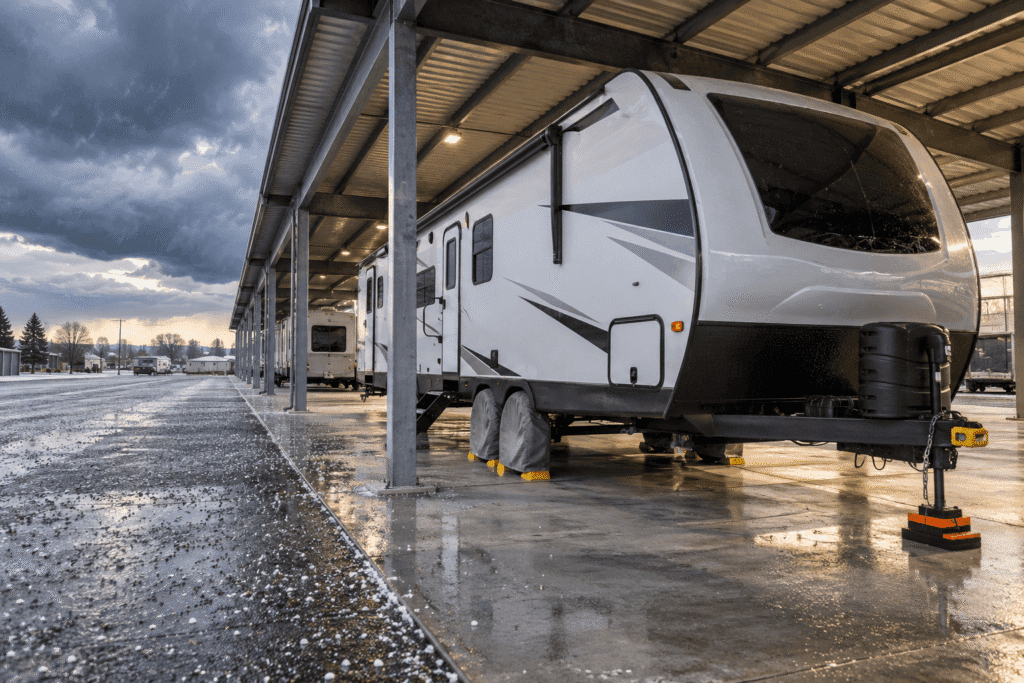
When your RV is parked for the season, it may be tempting to cancel the insurance until you are ready to travel again. After all, an RV that is not on the road cannot be involved in a driving accident.
Storage reduces some risks, but it does not eliminate them. An RV can still be damaged by hail, fire, theft, vandalism, falling objects, or severe weather while it is parked. Your lender, storage facility, registration status, and type of RV may also affect whether you can reduce or remove certain coverage.
Before making changes, review your policy with an insurance professional and understand exactly what protection would remain.
Stored RVs Still Face Property Risks
An RV does not need to be moving to experience a loss.
While it is stored, it may be exposed to:
- Theft or attempted theft
- Vandalism
- Fire
- Hail and wind
- Falling trees or branches
- Damage caused by animals
- Broken glass
- Objects falling inside a storage building
- Weather-related damage
Comprehensive coverage may address certain non-collision losses, depending on the policy. However, coverage remains subject to deductibles, exclusions, limits, and the cause of the damage.
Some problems associated with storage may not be covered. Gradual deterioration, wear and tear, corrosion, mold, pest infestations, freezing, and damage caused by inadequate maintenance are commonly restricted or excluded.
Insurance should therefore be combined with practical storage preparation rather than treated as a substitute for maintenance.
Motorhomes and Travel Trailers Are Treated Differently
The type of RV you own affects the coverage you may need.
Motorhomes
A motorhome is self-propelled and functions as a motor vehicle. When it is driven on public roads in Colorado, it must meet applicable auto insurance requirements.
If you reduce the policy to storage coverage, liability, collision, and other driving-related protections may be suspended or removed. You should not drive the motorhome again until the appropriate road coverage has been restored and confirmed.
Registration requirements may also affect whether liability coverage can be removed. Colorado generally requires proof of insurance to register or renew a motor vehicle, so confirm the consequences before changing a motorhome policy.
Travel trailers and other towable RVs
A travel trailer, fifth wheel, or pop-up camper does not have its own engine. Liability while it is being towed may extend from the towing vehicle under certain circumstances, but that does not necessarily cover physical damage to the trailer itself.
A separate RV policy may provide protection for the trailer, attached equipment, and certain personal belongings. The towing vehicle’s auto policy should not be assumed to provide all the coverage a towable RV needs.
Whether the RV is motorized or towable, review how your RV insurance coverage applies both on the road and in storage.
What Is RV Storage Insurance?
“Storage insurance” is usually not a completely separate type of policy. The term commonly refers to reducing an existing RV policy while the vehicle is not being used.
Depending on the insurer, this may be called:
- Storage coverage
- Seasonal coverage
- Lay-up coverage
- Comprehensive-only coverage
- A storage endorsement
The available option may retain comprehensive protection for certain non-collision losses while removing or suspending coverages associated with driving.
A reduced policy may cost less than maintaining the same coverage throughout the year, but it can also leave significant gaps. Terms, eligibility rules, minimum storage periods, and available coverages vary by carrier.
Do not assume that asking to “put the RV in storage” has the same effect with every insurer. Ask for a clear explanation of which coverages will remain, which will be suspended, and what must happen before the RV can be used again.
Can You Cancel RV Insurance During the Off-Season?
You may be able to cancel a policy, but doing so can create more consequences than reducing the coverage.
Cancellation could leave the RV without protection against theft, fire, hail, vandalism, or other losses. It may also:
- Violate a loan or lease agreement
- Create a lapse in insurance history
- Affect registration requirements for a motorhome
- Leave personal belongings inside the RV uninsured
- Require a new application or inspection when coverage is restored
- Expose you to a loss while transporting or repositioning the RV
If the RV must be driven—even briefly—you would need to restore the required coverage first. Moving it from one storage space to another, taking it for maintenance, or driving it home before a trip can create a serious gap if the policy still reflects storage-only use.
Reducing coverage may be an option, but canceling it entirely deserves careful consideration.
Your Lender May Require Continuous Coverage
If you financed or leased the RV, the agreement may require you to maintain physical damage coverage throughout the loan or lease term.
The lender has a financial interest in the RV and may require comprehensive and collision coverage even when it is stored. Canceling or reducing the policy without checking the agreement could violate those requirements.
If required insurance lapses, a lender may purchase coverage that protects only its interest and charge you for it. This coverage can be more expensive and may not protect you in the same way as your own RV policy.
Contact both your insurance professional and lender before making seasonal changes.
Does the Storage Facility Insure Your RV?
A storage facility may carry insurance for its buildings, operations, or liability, but that does not mean it insures every RV stored on the property.
The rental agreement may make the RV owner responsible for insuring the vehicle and its contents. The facility’s policy may not pay for damage to your RV simply because the loss occurred on its premises.
Before choosing a facility, ask:
- Does the agreement require proof of insurance?
- Is the RV stored indoors, under a roof, or outside?
- What security measures are used?
- Is the property gated and monitored?
- Who may access the storage area?
- Are there restrictions on propane tanks or batteries?
- What does the agreement say about weather damage, theft, or fire?
- Is the facility located in an area exposed to flooding, hail, wildfire, or falling trees?
Keep a copy of the storage agreement and confirm your insurer knows where and how the RV will be stored.
What About Personal Belongings Inside the RV?
RVs often contain camping equipment, electronics, clothing, cookware, tools, bicycles, and other personal items.
Coverage for those belongings can vary. An RV policy may provide a specific amount of personal-effects coverage, while a homeowners or renters policy may provide limited off-premises protection under certain circumstances.
High-value equipment may require additional coverage or documentation. Items used for business may also be treated differently from personal property.
Before storing the RV:
- Remove cash, medications, important documents, and irreplaceable items
- Create a photo or video inventory of what remains
- Record serial numbers for valuable equipment
- Ask which policy would respond if belongings were stolen or damaged
- Confirm the applicable limit and deductible
Avoid leaving valuable property in the RV simply because it is stored at a secured facility.
When Can Reducing Coverage Make Sense?
Seasonal or storage coverage may be worth considering when:
- The RV will not be driven or moved for an extended period
- It is stored in a secure location
- The lender permits reduced coverage
- Registration requirements have been addressed
- You understand which protections will remain
- You have a clear process for restoring coverage before use
Maintaining broader coverage may make more sense if you use the RV unpredictably, move it during the winter, live in it part time, lend it to others, or keep it somewhere with significant weather or theft exposure.
The appropriate decision depends on the RV, its value, how it is financed, where it is stored, and how soon you may use it again.
Questions to Ask Before Changing Your Policy
Before reducing or suspending any RV coverage, ask your insurance professional:
- Which coverages remain while the RV is in storage?
- Would theft, fire, hail, wind, or vandalism be covered?
- What losses are excluded?
- Does the storage location affect eligibility or price?
- Is there a minimum storage period?
- Can the RV be moved under storage coverage?
- What must I do before driving or towing it again?
- Will my lender allow the change?
- Could the change affect registration?
- How are personal belongings and attached equipment covered?
- Will the adjustment create a lapse in coverage?
- How quickly can full coverage be restored?
Request written confirmation of any policy change and its effective date. Do not drive or tow the RV based only on the assumption that coverage has automatically resumed.
Prepare the RV for Storage
Good preparation can reduce the likelihood of damage and make future claims easier to document.
Depending on the RV and storage conditions, preparation may include:
- Winterizing the plumbing system
- Checking the roof, seals, windows, and exterior
- Removing food and other items that attract pests
- Disconnecting or maintaining batteries appropriately
- Securing propane and other fuel sources
- Inflating and protecting the tires
- Using an appropriate RV cover
- Photographing the interior and exterior
- Recording the mileage and condition
- Locking doors, windows, compartments, and hitch components
- Visiting the RV periodically when permitted
Follow the manufacturer’s maintenance recommendations and the storage facility’s rules. Damage caused by neglected maintenance or gradual deterioration may not be covered.
Review Your RV Coverage Before the Off-Season
You may still need RV insurance while your motorhome, travel trailer, or camper is in storage. Although some driving-related risks decrease, the RV remains exposed to property damage, theft, weather, and other losses.
Rather than canceling the policy automatically, consider whether a seasonal or storage option is available and appropriate. Confirm any lender and registration requirements, understand what will remain covered, and establish how full protection will be restored before the RV moves again.
Warrior Insurance and Services Group can compare available options from multiple carriers and help you evaluate coverage for your RV during both travel and storage. Request an insurance review before making seasonal changes to your policy.
